

“Breaking the Limits with ‘Chemical Locking’… Incheon National University Boosts the Commercialization Potential of High-Efficiency Tandem Organic Solar Cells”
- 글번호
- 417719
- 작성일
- 2026-01-12
- 수정일
- 2026-01-12
- 작성자
- 홍보과 (032-835-9490)
- 조회수
- 20
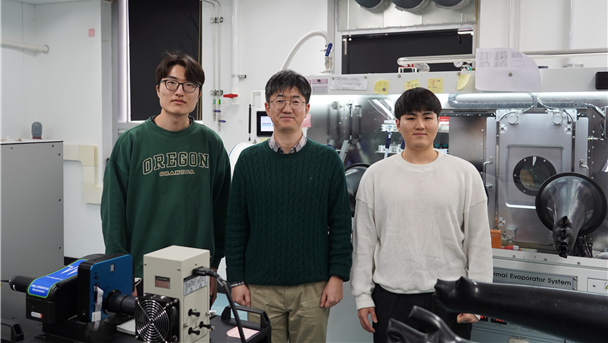
Professor Jin-ho Lee Research Team, Department of Physics
Achieving both efficiency and stability in next-generation high-efficiency tandem organic solar cells through the development of an ultra-strong “chemical locking” interfacial technology, raising expectations for commercialization
A Korean research team has developed a core technology that simultaneously enhances the performance and lifespan of tandem organic solar cells, which are gaining attention as next-generation eco-friendly energy sources.
Incheon National University (President: In-jae Lee) announced that the research成果 of the team led by Professor Jin-ho Lee of the Department of Physics was published in the December 14 online edition of Advanced Energy Materials, a world-renowned international journal in the field of energy materials (Impact Factor 26%, top 2.5% in JCR). The paper is titled “Chemically Passivated Polymeric Charge Recombination Layer for Efficient Tandem Organic Solar Cells.”
Organic solar cells are considered a “dream energy source” because they are lightweight, flexible, and can be made transparent, making them applicable to a wide range of fields such as building-integrated photovoltaics (BIPV) and wearable devices. In particular, homo tandem organic solar cells, in which two solar cells absorbing the same wavelength range are vertically stacked, can achieve higher efficiency than single-junction devices and are regarded as a key technology for commercialization.
However, in tandem structures, stably implementing the charge recombination layer that electrically connects the top and bottom cells has been a major process challenge. Conventionally, polyethyleneimine (PEI), which forms interfacial dipoles to control the Fermi level, has been used. However, PEI has been reported to chemically attack Y6 (BTP-4F), a core material in organic solar cells, causing severe degradation of device performance.
To address this issue, Professor Lee’s research team applied a combination of the conductive polymer PEDOT:PSS and PEI to the charge recombination layer.
The team identified that protons (H⁺) derived from PEDOT:PSS immediately protonate PEI in situ, weakening PEI’s reactivity toward Y6. In other words, PEDOT:PSS acts as a form of chemical passivation that protects the Y6 material while enabling the charge recombination layer to stably perform its required electrical functions.
Tandem organic solar cells incorporating this technology achieved a high efficiency of over 18 percent and were confirmed to operate stably for extended periods under real solar illumination conditions.
Professor Jin-ho Lee of Incheon National University, who led the research, stated, “Beyond improving device efficiency, this study is significant in that it fundamentally elucidated and controlled the complex chemical interactions between polymer electrolytes and organic semiconductors that had not been clearly understood until now.” He added that this technology “will accelerate the commercialization of organic solar cells and make a crucial contribution to securing the stability of next-generation optoelectronic devices.”
This research was carried out through industry–academia–research collaboration centered on Researcher Kyung-sik Kim (first author) of the Department of Intelligent Semiconductor Engineering at Incheon National University, together with Researchers Ki-chan Son and Jae-ho Shin of the Department of Physics; Professors Jung-woo Kim, Soo-bong Choi, Byung-hee Moon, and Jun-ho Kim; Drs. Eun-chong Chae and Soon-il Hong of the Korea Research Institute of Chemical Technology; and Dr. Min-gyu Kyung of the global materials company Dow Inc.
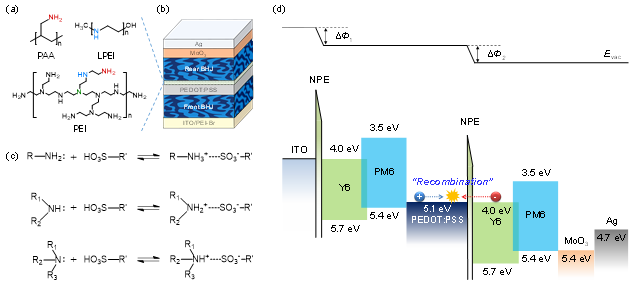
Research Materials